Our curriculum
More than what we teach. What sets us apart.
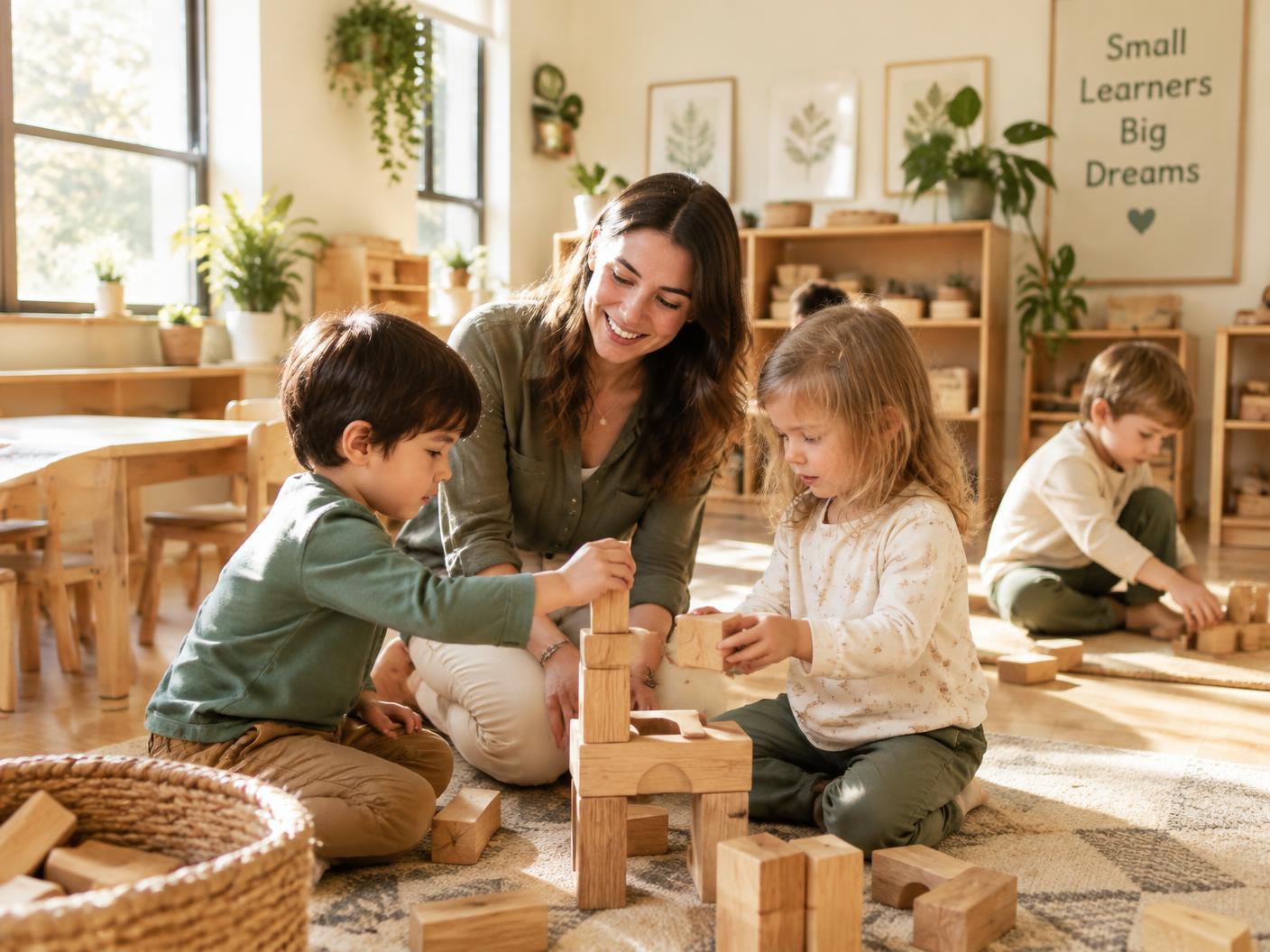
Our curriculum is more than what we teach — it is what sets us apart and brings our community together. Innovation Advantage™ gives children opportunities to problem-solve, collaborate, create, test ideas, and communicate their thinking.
Every lesson runs The CAPE Method™: Challenge → Analyze → Produce → Evaluate.
01 · The method
Four steps. Hundreds of chances to practice them.
The topics rotate — birds, bridges, water, shadows, shops. The thinking never does. Every lesson runs the same four-step structure, so quality is visible from classroom to classroom and school to school.
Challenge
What's the problem?
Not a topic. Not a theme. A real problem a four-year-old can see, touch and genuinely care about — something worth wondering about or solving.
Analyze
What do we notice?
They look closely before deciding what to do. Sort, compare, test, question, investigate — with real materials in their hands.
Produce
What could we make?
Thinking becomes something you can hold: a model, a design, a structure, a story, a solution. Their idea — never a kit.
Evaluate
Did it work?
Children look at what actually happened, decide what they'd change — and change it. Then the cycle begins again. A child who meets the same structure every week learns to use it.
02 · One lesson, start to finish
The Bird Feeder Challenge.
One real lesson, taught at our lab school — The CAPE Method™ doing its job. Follow the four steps.
Step 1 · Challenge
“The birds outside our window have nothing to eat. How can we help them?”
It begins with a problem the children can see out their own window — and genuinely care about.
Step 2 · Analyze
They investigate before they build.
They watch which birds visit. They research what those birds eat. They test which materials hold seed — and which fall apart in the rain.
Field notes from the classroom
- “cardboard gets soggy”
- “the red birds like the sunflower seeds”
- “we need a roof”
Step 3 · Produce
Each child builds their own feeder.
Not a kit. Not twenty identical feeders on a wall. Their idea. Their design. Built from materials they chose and argued about.
Step 4 · Evaluate
The feeders go outside. Then the children watch.
Which ones hold seed? Which survive the rain? Which do the birds actually use? The ones that fail get rebuilt — because the birds still need them.
Children don’t find out whether they got it right. They find out what happened — and decide what to do next. That’s the whole curriculum in one move.
Notice what just happened: nobody told the children the answer. That feeling is the curriculum. The topics change every year; the four steps — and the habits they build — never do.
03 · What children are building
Six things your children build, every day.
Curiosity
Curiosity treated as a skill to develop — not a phase to manage until it passes.
Built by — The teacher answers a question with a better question, and waits.
Critical Thinking
Reasoning and problem-solving, practiced on real problems instead of worksheets.
Built by — Predictions said out loud, in front of other children, before anything is tested.
Creativity
Challenges that reach beyond the classroom — not just the lesson plan.
Built by — Problems that arrive on their own: the puddle, the quiet courtyard, the door that sticks.
Problem Solving
Building with their hands, toward an outcome they chose themselves.
Built by — Real materials, no kits — and the version that will not work is allowed to get built.
Communication
Teamwork, communication, and noticing what someone else needs.
Built by — Rotating roles — researcher, builder, recorder — so nobody hides in the same job all year.
Agency
Resilience comes from failing at something small, on purpose, with a teacher nearby.
Built by — Hundreds of small survivable failures before kindergarten, each followed by a second attempt.
04 · The balance
Serious thinking. Still childhood.
Children here build. Paint. Dig. Pretend. Run. Make friends. Make enormous messes. Ask impossible questions. Teachers sit beside them, listen to their theories, and know when to help — and when to wait. Because figuring things out starts with feeling safe enough to wonder.
Overheard in class this week
- “I have a theory about that.”— age 5
- “Can we test it?”— age 4
- “It broke. I know why.”— age 4
- “Let’s ask the birds.”— age 3
- “I’ll try it a different way.”— age 3
- “We need more tape. A LOT more tape.”— age 5
05 · Built here
A lesson isn’t finished because someone wrote it.
Lessons are taught, observed, argued over, revised, and taught again — with real children, in our own classrooms at The Winter Park School. When a lesson doesn’t work with real four-year-olds, we don’t blame the child. We improve the lesson.
Every lesson a member school receives was tested here first — then revised before it shipped.
06 · What member schools receive
The curriculum, ready on day one.
A full year, ready on day one
Every CAPE lesson lives in the platform — each one about 30 minutes, with every step, material and teacher prompt written out.
An add-on, not a replacement
Your school keeps its curriculum. Teachers add ready CAPE lessons alongside what they use today.
Ages 3–6
One method across the early years, so the standard holds from room to room and year to year.
Delivered by any teacher
A first-year teacher can run it on day one; a twenty-year veteran goes deeper inside the same structure.
Parents are looking for future-ready education, and our curriculum gives us a powerful story to share during tours:
“We’re not only preparing children for their next classroom. We’re developing the creativity, confidence, collaboration, and problem-solving skills they’ll need for their future.”
That is our differentiator — and a powerful enrollment message.
Come watch them think.
Visit the lab school on an ordinary day and watch a real CAPE lesson with real children — or apply to the founding cohort and put the curriculum in your own classrooms.